Sabtu, 27 Mei 2017

KAUM ANDALOUSE DI ZAGHOUAN, TUNISIA

40 HARI MENGASIHI BANGSA DALAM DOA -- MINGGU, 28 MEI 2017

KAUM ANDALOUSE DI ZAGHOUAN, TUNISIA

Kota pegunungan Zaghouan terletak pada 45 mil utara kota Tunis, ibu kota Tunisia. Sebagian besar dari 40.000 orang yang mendiami kawasan ini memiliki leluhur yang berasal dari orang-orang Muslim Andalusia yang dipaksa oleh orang Spanyol untuk melarikan diri pada masa pengusiran orang Muslim selama abad ke-17. Sungguh merupakan sesuatu yang mengejutkan bahwa Islam tersebar luas di Spanyol selama sembilan abad.

Para pengemudi taksi, penjaga-penjaga toko, ibu-ibu, dan anak-anak akan begitu fasih untuk menceritakan kepada saudara tentang sejarah mereka yang membanggakan.

Mereka menceritakan tentang pelarian mereka ke Zaghouan, dengan harta mereka yang paling berharga yang tersembunyi di dalam permen putih, kecil, dan bulat, agar tidak dirampok di perjalanan mereka yang sulit. Sekarang, Zaghouan terkenal karena kue kering kecil dan bundar, yang disebut Kaak Warka, terbuat dari adonan dan almond yang dicampur dengan air mawar.

Bagi orang Tunisia, Zaghouan adalah tempat tamasya yang terkenal. Pengunjung dapat menemukan sisa reruntuhan Romawi yang megah. Pegunungan ini berhutan dan indah, dan sering kali berselimut salju pada saat musim dingin. Dahulunya, orang-orang asing biasa datang ke kawasan ini, tetapi semenjak serangan teroris pada tahun 2015, pariwisata di Tunisia mengalami dampak yang buruk, banyak hotel yang tutup. Penduduk setempat mencemaskan para wisatawan tidak akan datang kembali. Sejak revolusi 2011, banyak warga Tunisia tidak yakin akan apa yang bisa dibuat dari tempat baru mereka di dunia ini, dan mereka tidak percaya pada pemerintah mereka yang sekarang.

Selama masa pemerintahan Kaisar Romawi Hadrian, saluran air sepanjang 82 mil dibangun untuk memasok air dari Zaghouan ke kota Carthage. Kuil Air masih berdiri megah di lereng bukit, tempat sumber air pernah memancar di sana, dan sekarang sangat kering, ini menjadi pengingat akan air yang bermakna rohani yang diberikan di tanah yang kering ini. Baru-baru ini, tim doa mengunjungi daerah ini dan berdoa agar kehidupan akan memancar kembali dari Zaghouan, dan agar negeri yang kering dan tandus ini akan menemukan harapannya dalam "Sumber Kehidupan Kekal".

Mari kita berdoa:

- Untuk stabilitas dan perdamaian di Tunisia dan untuk kepemimpinan yang bijaksana.

- Agar sumber-sumber air kehidupan mengalir masuk dan keluar dari Zaghouan, seperti yang Yesus jelaskan dalam Yohanes 4.

British Investigators Arrest More Suspects as More is Learned about Manchester Bomber

British Investigators Arrest More Suspects as More is Learned about Manchester Bomber

By Michael Ireland, Chief Correspondent for the ASSIST News Service (www.assistnews.net)
MANCHESTER, ENGLAND (ANS - May 27, 2017) -- British authorities are making headway in trying to contain the network they believe is behind the Manchester attack as it emerged that the suicide bomber, Salman Abedi, reportedly spoke to his brother in Libya just 15 minutes before he detonated his explosives, according to CNN.
"We are following up on the network, rolling it up, trying to contain it. As you've seen from the number of arrests, we are on the right track to try to contain it," UK Security Minister Ben Wallace told CNN in Manchester on Friday. "In the end, you get to the bottom of a network."
mi Manchester suicide bomber Salman Abedi 05 27 2017CNN has reported that investigators continue to work around the clock to track down associates of Abedi, a 22-year-old Briton of Libyan descent, amid fears he is part of a network plotting further mayhem.
On Friday, authorities arrested a man from Manchester's Rusholme neighborhood. Then, two more men were arrested early Saturday, police said in a statement. The men were taken into custody after officers carried out a controlled explosion to enter a home in the Cheetham Hill area of central Manchester.
CNN said these actions brought the total number of people arrested in the investigation to 13, with 11 still in custody. Two people have been released without being charged, Greater Manchester police said.
Media reports say Salman Abedi’s brother, Hashim Ramadan Abu Qassem al-Abedi, was arrested in Libya on Tuesday.
Abedi’s younger brother -- detained in Libya in the aftermath of the bombing – is reported to have known of his brother's movements and about the plot, Ahmed Ben Salem, spokesman for the Special Deterrence Force in Tripoli, told the private broadcaster, Libya's Channel, on Thursday night.
Ben Salem said the brothers spoke on the phone just minutes before the attack at a concert at Manchester Arena, but Hashim told his Libyan interrogators that he did not know details about where and when the blast would be.
mi hashim ramadan abu qassem al abedi 05 27 2017CNN reports the Special Deterrence Force in Tripoli, a militia nominally under the control of Libya's interior ministry, arrested Hashim al-Abedi a day later on suspicion of links to ISIS otherwise known as Islamic State (IS). The militia also arrested the brothers' father, Ramadan al-Abedi.
CNN said that earlier this week the militia said Hashim had admitted -- under interrogation -- that he and Salman were members of IS. It also said Hashim was in Manchester during the planning for the attack and that he had been aware of the plot.
Ben Salem told Libya's Channel that Salman Abedi entered Libya on April 19 and left on May 17, telling his family that he was going to Saudi Arabia to perform the Umrah pilgrimage. It was a deception, and only his brother Hashim knew that Salman actually returned to the UK, according to Ben Salem.
Asked if there was any indication Salman Abedi had received training in Libya or planned an attack inside Libya, Ben Salem said, "I don't think so." Based on what the bomber's brother has told the militia, "everything was prepared in Manchester" since the end of 2016, he said.
US officials told CNN this week that it is likely Salman Abedi received some IS training by traveling to Syria in the months before the bombing, according to information gathered in the preliminary investigation.
Monday's attack on concert-goers leaving an Ariana Grande show killed 22 people, many of them children, and injured dozens more.
In her first comments since the attack, Grande said Friday in a note on Twitter that she is sorry for the "pain and fear" her fans are feeling. She said the fans killed Monday will be on her mind and in her heart forever.
"I will think of them with everything I do for the rest of my life," said the singer, who also announced Friday that she will hold a benefit concert in honor of the victims of the Manchester attack.
What is his family background?
Prayer vigil in ManchesterBritain’s Telegraph newspaper (www.telegraph.co.uk) reports Abedi was born and raised in Manchester in 1994, the second youngest of four children, and grew up in a Muslim household, but matured into a university dropout with an appetite for bloodshed.
His parents, mother Samia Tabbal and father Ramadan Abedi, a security officer, are Libyan-born refugees who fled to the UK to escape Gaddafi. It is thought they returned in 2011 following Gaddafi’s overthrow.
Abedi is thought to have an older brother Ismail Abedi, who was born in Westminster in 1993, a younger brother Hashim Abedi, and a sister Jomana, whose Facebook profile suggests she is from Tripoli and lives in Manchester.
A family friend, who asked not to be named, said the family were known to the Libyan community in the city and described Abedi as "normal." He told the Press Association (PA): "He was always friendly, nothing to suggest (he was violent). He was normal, to be honest."
Abedi is believed to have attended the Manchester Islamic Center, also known as the Didsbury Mosque.
Sheikh Mohammad Saeed said he believed Abedi had displayed a "face of hate" after the imam gave a sermon denouncing terrorism.
Abedi's education
The Telegraph reported that Abedi went to Burnage Academy for Boys between 2009 and 2011, and then on to Salford University in 2014 where he studied business management before dropping out, according to a source.
The Telegraph source said Abedi began his course in 2014 and attended lectures for two years but then stopped going. He would have graduated this summer. He did not live in university accommodation, had not been in any trouble at the university, and was not on any radar for pastoral or social care.
It is understood Abedi was not known to have participated in any clubs or societies during his time in higher education and never met with the resident imam.
Where did he live?
girl being helped after Manchester bombingHe was registered as living at the Abedi family home Elsmore Road, south Manchester as recently as last year, where plainclothes police raided a downstairs red-bricked semi-detached property on Tuesday.
The newspaper said neighbors recalled an abrasive, tall, skinny young man who was little known in the neighborhood, and often seen in traditional Islamic clothing. He is thought to have lived at a number of addresses in the area, including one in Wilbraham Road, where officers arrested a man on Tuesday.
Abedi previously lived with his parents and a brother.
What have the neighbors said?
Neighbors in Elsmore Road told how Abedi had become increasingly devout and withdrawn.
Lina Ahmed, 21, said: “They are a Libyan family and they have been acting strangely. A couple of months ago he [Salman] was chanting the first kalma [Islamic prayer] really loudly in the street. He was chanting in Arabic.
“He was saying ‘There is only one God and the prophet Mohammed is his messenger.’”
A family friend, who described the Abedis as “very religious,” said most of the family had returned to Libya, leaving only Salman and his older brother Ismail behind.
“They have not been there for quite a while. Different people come and go,” said Alan Kinsey, 52, a car-delivery driver who lives across the street. Kinsey’s wife, Frances, 48, a care worker, said she believed that the parents had left before Christmas and just one or two young men had been living in the property.
Kinsey said a huge flag, possibly Iraqi or Libyan, had been hanging from their house. “There was a large Iraqi flag hanging out the window but we never thought anything of it,” Kinsey added. “We thought it was about football or a protest at home or something.”
How did he become radicalized?
Vigil at Manchester Peter WoodingAbedi has "proven" links with Islamic State, according to France's interior minister as cited by The Telegraph.
Gerard Collomb told French television that both British and French intelligence services had information that Abedi had been in Syria. Collomb said: "All of a sudden he travelled to Libya and then most likely to Syria, became radicalized and decided to commit this attack."
Abedi had been a "regular kid," who went out and drank until around a year ago when he "dropped off the radar," the Times reported the bomber's former landlord's nephew as saying.
The paper quoted a friend as saying he had returned from a three-week trip to Libya in recent days.
Abedi's trips to Libya are now subject to scrutiny, including links to jihadists.
A group of Gaddafi dissidents, who were members of the outlawed Libyan Islamic Fighting Group (LIFG), lived within close proximity to Abedi in Whalley Range.
Among them was Abd al-Baset Azzouz, a father-of-four from Manchester, who left Britain to run a terrorist network in Libya overseen by Ayman al-Zawahiri, Osama bin Laden’s successor as leader of al-Qaeda.
Azzouz, 48, an expert bomb-maker, was accused of running an al-Qaeda network in eastern Libya. The Telegraph reported in 2014 that Azzouz had 200 to 300 militants under his control and was an expert in bomb-making.
How was he identified?
It has emerged in US media reports that the bomber was identified by a bank card in his pocket.
According to NBC News, citing a US intelligence official, members of the bomber's family warned security officials about him in the past, saying that he was “dangerous.”
The official told the broadcaster that Abedi likely "had help" making the “big and sophisticated bomb."
Has his family spoken?
Speaking for the first time about his son's death, Abedi's father said: "We don't believe in killing innocents. This is not us."
Speaking from Tripoli, he told AP this his son was innocent and confirmed that British police had arrested another of his sons, believed to be a 23-year-old arrested in south Manchester on Tuesday.
Abedi's sister, Jomana, suggested he carried out the attack for revenge on US air strikes in Syria.
Shock after Manchester terror attack“I think he saw children -- Muslim children -- dying everywhere, and wanted revenge," she told the Wall Street Journal. "He saw the explosives America drops on children in Syria, and he wanted revenge. Whether he got that is between him and God.”
His brother Hashim reportedly knew he was planning the attack. "His brother felt there was something going on there in Manchester and he thought his brother would do something like bombing or attack. So after that, he told us, 'Having internet, I see the attack in Manchester and I knew that's my brother'," a spokesman for Libyan authorities told BBC2's Newsnight.
He revealed that Abedi's younger brother Hashim had been investigated for about a month and a half over suspicions that he was linked to IS.
"We were not quite sure about this, but when we arrested and we asked him, he told us, 'I have ideology with my brother'. Hashim told us, 'I know everything about my brother, what he was doing there in Manchester.'"
CNN's Hala Gorani reported from Manchester and Laura Smith-Spark wrote and reported from London. CNN's Lonzo Cook, Jomana Karadsheh, Mariano Castillo, James Gray, Richard Allen Greene, Sarah Chiplin and Barbara Starr contributed to the original CNN report. Martin Evans, Victoria Ward, Robert Mendick, (Chief Reporter), Ben Farmer, (Defense Correspondent), Hayley Dixon and Danny Boyl, contributed to the original Telegraph report.
Photo captions: 1) Salman Abedi (Facebook). 2) Hashim al-Abedi (CNN) 3) Messages left at Manchester vigil. 4) Injured girl being helped to safety. 5) Scene at the vigil (Peter Wooding). 6) Shock in the face of a woman after the bomb blast. 7) Michael Ireland.
Ireland Michael FEB.2009 320x276About the Writer: Michael Ireland is a volunteer internet journalist serving as Chief Correspondent for the ASSIST News Service, as well as an Ordained Minister who has served with ASSIST Ministries and written for ANS since its beginning in 1989. He has reported for ANS from Jamaica, Mexico, Nicaragua, Israel, Jordan, China, and Russia. Please consider helping Michael cover his expenses in bringing news of the Persecuted Church, by logging-on to: https://actintl.givingfuel.com/ireland-michael
** You may republish this or any of our ANS stories with attribution to the ASSIST News Service (www.assistnews.net). Please also tell your friends and colleagues that they can get a complimentary subscription to ANS by going to the website and signing up there.

BERDOA BAGI KELUARGA MUSLIM

40 HARI MENGASIHI BANGSA DALAM DOA -- MINGGU, 28 MEI 2017

BERDOA BAGI KELUARGA MUSLIM

Keluarga bersifat kompleks/rumit. Keluarga kita sangat menentukan siapa diri kita dan dipengaruhi oleh banyak faktor. Tak ada keluarga yang sama, dan ketika kita menyelidiki kehidupan keluarga di dunia Muslim, kita akan menemukan perbedaan-perbedaan maupun kesamaan-kesamaannya.

Dalam edisi ini, kita akan menyoroti keanekaragaman yang ada dalam keluarga-keluarga Muslim. Seperti halnya yang terjadi di keluarga-keluarga Kristen, demikian pula budaya, tradisi, pendidikan, pengalaman, dan kesempatan-kesempatan memengaruhi bagaimana keluarga Muslim itu menjalani kehidupannya di seluruh dunia. Dari generasi ke generasi, keluarga-keluarga menanggapi dan menyesuaikan diri dengan perubahan budaya, masyarakat, dan teknologi yang berlangsung cepat maupun lambat. Kita akan melihat bagaimana hal ini berpengaruh kuat dalam keluarga-keluarga Muslim di berbagai wilayah.

Saudara juga akan melihat berbagai hal yang bersifat umum: korban-korban persembahan dilakukan oleh orangtua agar anak yang dikasihinya memperoleh peluang yang lebih baik; kecemasan-kecemasan terhadap anak-anak yang sedang bertumbuh dalam keterlibatannya dalam masyarakat yang semakin tidak menentu; kesukacitaan dan pergumulan dibagikan oleh pasangan yang telah menikah; dan perhatian terhadap orangtua yang sudah Ianjut umur. Kita berdoa dengan memahami pokok-pokok permasalahan mereka.

Jumat, 07 April 2017

Arab, Yemeni in Yemen

Arab, Yemeni in Yemen
Yemen is very poor. Most of the population is engaged in growing grains, vegetables, fruit, cotton, coffee, and khat (a stimulant-containing shrub), and raising sheep, goats, and camels. Foreign aid and remittances from Yemenis working abroad are important to the economy. Once part of the ancient Sabaean kingdom (750 BC-115 BC), Yemen was later ruled by the Himyarites, Romans, Ethiopians, and Persians. It was conquered by Muslim Arabs in the 7th century AD.
Ministry Obstacles
Yemen provides a hostile environment to Christian workers.
Outreach Ideas
Bridges of friendship and trust are needed with the Arabs of Yemen. Christians can help them in material and physical ways.
Pray for the followers of Christ
Pray the few followers of Christ among the Ta'izz-Adeni Arabs will cling strongly to their faith in a harsh environment. Pray the Lord will protect them and teach them to fully trust in himself for life.
Pray for the entire people group
Pray for the Arabs of Yemen to improve their standard of living, find employment and provide schooling for their children.
Scripture Focus
"He will have compassion on the poor and needy, And the lives of the needy He will save." Psalm 72:13


People Name: Arab, Yemeni
Country: Yemen
10/40 Window: Yes
Population: 6,611,000
World Population: 7,413,000
Language: Arabic, Taizzi-Adeni Spoken
Primary Religion: Islam
Bible: None
Audio NT (FCBH): No
Jesus Film: Yes
Audio Recordings: Yes
Christ Followers: Few, less than 2%
Status: Unreached
Progress Level:

Give a Bible to a Believer Like Kumar

Pakistani Men

We Know Them by Name
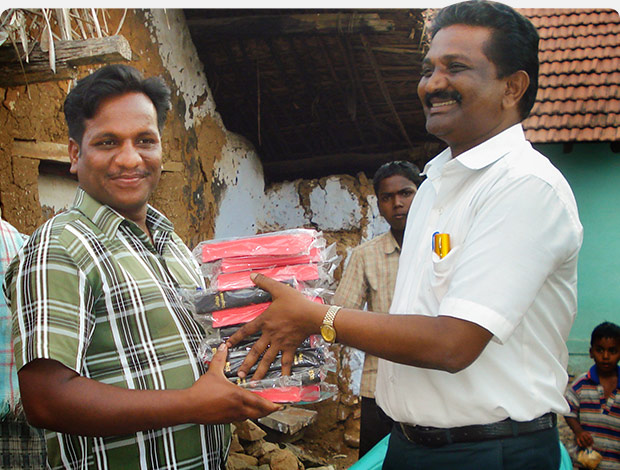
Pastor Kumar waited with about 50 others who had gathered in the small church sanctuary. They sat on plastic chairs, waiting for their name to be called. When a smiling man at the front looked at his list and said “Kumar!” the pastor stood up and made his way to the front. After being handed a red leather-bound study Bible, the first copy of the Scriptures he’d ever owned, he broke into a broad smile. “Praise God!” he exclaimed.

Help Send Bibles Now

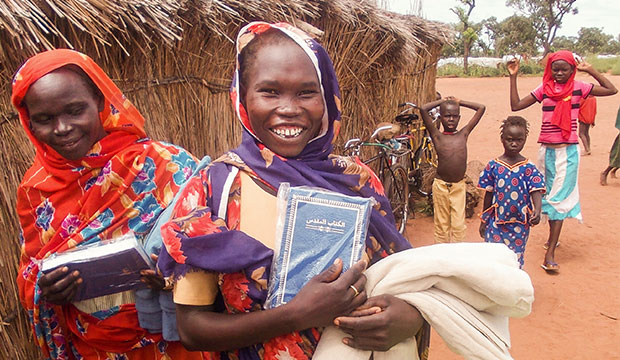
Girl with Bible
Kumar’s Bible was one of more than 300,000 distributed by The Voice of the Martyrs’ contacts in India last year and one of more than 1.2 million distributed worldwide. New believers in hostile and restricted nations need Bibles to help them grow, and pastors need Bibles to help them teach their congregations.

VOM has collected the names of tens of thousands of Christians who have asked for a Bible. When you sponsor Bibles through our “We Know Them by Name” campaign, VOM will send you the names of those who receive the Bibles so you can pray for them as they begin to read and share God’s Word.

Join us today in providing Bibles to believers in hostile and restricted nations.

Give a Bible to a Believer Like Kumar

Displaced Iraqis Escape Death in Mosul, Iraq

Displaced Iraqis Escape Death in Mosul, Iraq


April 6, 2017
Wrapped body of Christian woman being laid to rest in Iraq.
Islamic State militants last year killed a Christian woman identified only as Samira in Baghdaida, outside Mosul.
Some Iraqi civilians able to escape the Iraqi military's battle against the Islamic State (ISIS) for control of Mosul have not only avoided death but are finding life in Christ.
A displaced 10-year-old boy in northern Iraq was one of 600 kids who enjoyed an indigenous ministry's program at which children received Bibles and heard the gospel. Mahmood decided to put his faith in Christ for salvation, the ministry director said.
"That night, we asked the kids to go tell their parents about what they had heard and share the story of Jesus with everyone," the director said. "Mahmood's father came the next day complaining to us about our influence in his kid's decision to accept Christ."
The boy's father was upset and fearful of community backlash after hearing his son say, "I became a follower of Christ."
"His father had never heard a word about Jesus, so he gave us the opportunity to tell him about Christ and His salvation," the director said. "Not long after that, he accepted Christ and took Bibles for his wife and two daughters."
Ministries based in Iraq are in ideal position to provide aid, as they can purchase local items inexpensively and are familiar enough with local cultures to introduce the gospel along with relief items.
Other parents also approached the ministry leader with complaints about their children; they too ended up accepting Christ, he said. He gave them Bibles, and they told others of the peace and joy they had found in Jesus.
"Mahmood's father now has a Bible study in his house every Friday at 10 a.m. – the Muslim prayer day!" the director said.
Those stuck in Mosul face a reality that stands in sharp contrast with those who have fled. U.S-led coalition airstrikes in embattled western Mosul reportedly buried scores of civilians in rubble last month. Other civilians have succumbed to months of brutality by ISIS. Since the campaign to retake Iraq's second largest city from ISIS began on Oct. 17, desperate ISIS militants have tortured and killed civilians suspected of being sympathetic to the liberators. Prohibiting civilians from fleeing, the militants have sent the wounded into streets to lure into the open Iraqi forces seeking to help them, and they have kept women and children close by as human shields.
Iraqi forces, including the U.S.-led coalition airstrikes, are caught in a harsh dilemma. After the coalition forces retook eastern Mosul, an estimated 400,000 civilians are trapped in the city. ISIS militants are also trapped; surrounded by coalition forces, with no escape route or hope of victory, they have ensured that as many remaining civilians as possible meet a cruel end. Horrifying accounts by relatives of killed civilians are trickling out daily.
Partially destroyed building Near Mosul, Iraq.
Ruins of a building outside Mosul after destruction by Islamic State.
At least 355,000 civilians have been able to escape Mosul and its suburbs, Reuters reported, citing government figures. United Nations Secretary General Antonio Guterres last week said the international community must step up aid to help them.
Ministries based in Iraq are in ideal position to provide aid, as they can purchase local items inexpensively, know secure ways to distribute them and are familiar enough with local cultures to introduce the Bible and gospel along with relief items. They need only funding. All three camps in Khazar and Hassan Shami are full with displaced people from east Mosul, the director said.
"Despite the region still being in a state of war, large groups of displaced inhabitants are risking their lives trying to return home," he said. "Although this is dangerous, due to living conditions in the camps, the lack of resources and the cold weather, many are still trying. We provided some humanitarian support to the displaced that were in the camps, in the roads and in small villages located between the cities of Erbil, Dohuk and Mosul, but the need was much greater than our resources."
The ministry team recently came upon a village of Yarsanis (in Iraq called Kaka'in), followers of a syncretic religion founded in the late 14th century in western Iran by Sultan Sahak. The director said the team learned that they had militant tendencies, so the members spent much time in prayer before approaching them.
They went to the house of the village elder, religious leader Kaka Shehab, and told him about Christ. His daughter was ill with asthma, so they prayed for her before leaving him with a Kurdish-language Bible, the director said.
"The next day," he said, "he phoned us and said, 'My daughter has recovered, thanks to your prayers. Please, come back to the village and pray in every house and for everyone the same prayer that you prayed for her, and give Bibles to every house in the village."
The team returned and distributed 500 Kurdish-language Bibles, and they prayed for and explained Christ to all who received them, he said.
We pray and hope that all the followers of this religion will turn to Christ soon," he said. "Please Pray."
To help indigenous missionaries to meet needs, you may contribute online using the form below, or call (434) 977-5650. If you prefer to mail your gift, please mail to Christian Aid Mission, P.O. Box 9037, Charlottesville, VA 22906. Please use Gift Code: 444SHM. Thank you!

Drawing Life

Drawing by refugee girl.
With help from a student aide for an indigenous ministry in Jordan, a young refugee girl from Iraq expresses repressed feelings about atrocities by Islamic State terrorists. The director of the church school offering education to refugee children noted that a 7-year-old Iraqi girl had difficulty concentrating, a common symptom of Post-Traumatic Stress Disorder (PTSD). Also speech-delayed, she needed a student aide to help her adjust after the ordeal of escaping Iraq with her mother and brother. The family had spent a year sleeping on the streets and in parking garages. “Since starting at the church school, she is a lot happier,” the director said. “In the classroom she is happy to participate with the other students. Having a student aide/teaching assistant enables her to participate without distracting the rest of the class.” The ministry needs eight aides for eight traumatized children at a cost of $1,500 per month for all eight assistants – also refugees who benefit from the employment.